SAP introduced in August new Clean Core model for S/4HANA extensibility. We are officially saying good bye to the 3-Tier model and welcoming A,B,C,D level classification. This change makes the Clean Core more realistic for the customers by recognizing proven but not Cloud-Ready frameworks and tools like ALV, IDOC and WebClientUI.
A B C D Level – what is it all about?
New level concept is something different from the 3-Tier model it does have though certain touchpoints with the predecessor.
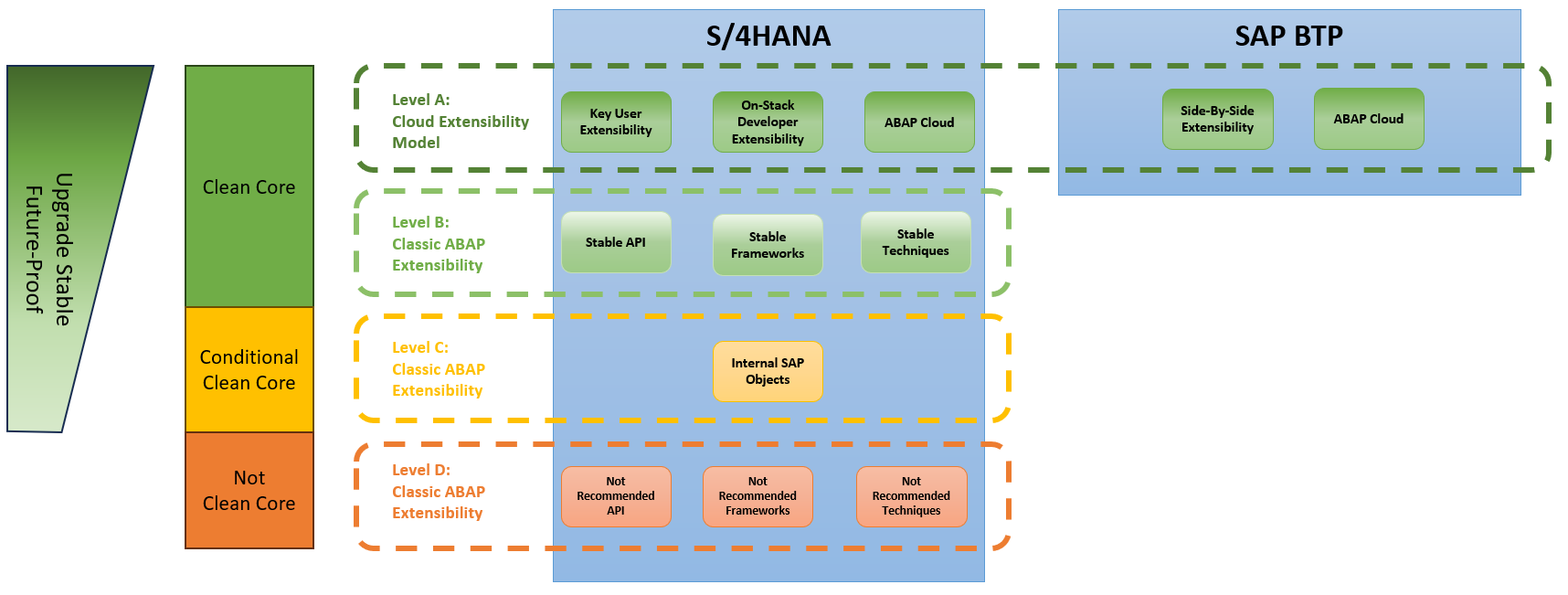
Level A -> Clean Core, Cloud Ready
This level is the old Tier 1. It means using the extension techniques like:
This level is also called “Cloud Ready” meaning that it is compatible with S/4HANA Public Cloud.
Level B -> Clean Core, Classic APIs
This is a new element in the concept. It allows to use so called stable APIs, frameworks and techniques, that are not released for ABAP Cloud but they are well established and stable enough to say that they do not pose a threat in terms of having a system future-proof. The objects can be found in the Cloudification Repository: LINK . They are marked as “Classic API”.
Although this level is called Clean Core, it is not Cloud Ready meaning that it could not be shifted to S/4HANA Public Cloud
Level C -> Conditional Clean Core
This level represents extensions that are using the objects that are not on the list of the “released” (Level A), “Classic API” (Level B) or “Not recommended” (Level D). It requires using a “Changelog for SAP Objects” to mitigate the risks during updates of an S/4HANA System.
Level D -> Not Clean Core
In this level the extensions will be classified that that use the “not recommended” objects and techniques. The list of objects can be found in the Cloudification Repository: Link . These Objects are marked as “No API” and should be avoided.
Good News for S/4HANA Service
With the new ABCD Level concept, certain frameworks and techniques have been assessed and assigned to corresponding Clean Core Level. For the customers using the Service Module one of the important take aways is that the User Interface enhancements with underlying WebClientUI framework now are classified as a B Level – Clean Core. That is a huge step forward since the vast majority of the Fiori Apps in Service are built on this framework.
Conclusion
Following previous 3-Tier model often led to difficult decisions between spending a lot of effort on a building a complex solution and having a core clean with Tier 1 and or going a classic way saving time but landing in Tier 2 or 3 and having the core that is no longer clean. Shift of the Clean Core for extensibility to the A-B-C-D Level concept is a major improvement. The main advantage is recognising the old and well established tools, frameworks and development objects, which are not released for ABAP Cloud but they do not pose a risk while upgrading the S/4HANA System making the investment future-proof and upgrade-safe.
Ready to Take the Next Step?
At 4cx, we help customers balance innovation with Clean Core principles. If you’re exploring your S/4HANA Service journey, let’s talk about how to make extensions both powerful and sustainable.